
IATF 16949-ready
Quality system alignment
Flex circuits engineered for the automotive reliability envelope — EV battery management, ADAS sensor arrays, cabin electronics, and under-hood telemetry. Process discipline aligned to IATF 16949-style expectations with thermal, humidity, and bend-cycle validation packages.
Automotive electronics — especially EV drivetrain, ADAS, and connected-car systems — run in environments that punish flex circuits: thermal cycles, vibration, humidity, and flex fatigue over vehicle lifetime. CircuFlex applies the process discipline and validation framework required by Tier-1 and Tier-2 automotive customers, with documentation aligned to IATF 16949-style expectations.
Automotive OEMs and Tier-1s need PPAP-ready documentation, reliable validation data, and disciplined response to field issues. CircuFlex is built around those expectations.
Control plan, PFMEA-aligned process controls, PPAP-ready sample data book — the evidence package Tier-1 SQE teams expect.
Thermal cycling, damp heat, and static-bend / dynamic-flex testing aligned to application environment — validated before PPAP sign-off.
0.05 mm trace/space and laser drilling for the compact FPC layouts used in ADAS cameras, radar modules, and driver-monitoring systems.
PI base film as default for automotive — proven thermal stability across the -40°C to +125°C automotive envelope.
Au, Sn, Ni, OSP — selected per application for solderability, longevity, and corrosion resistance in the automotive environment.
Full material-to-lot-to-test traceability — supports the recall and CAPA response expectations of the automotive industry.
Standard capability envelope. Alternative configurations available on request — send your design brief and we’ll respond with the matching process route.
| Minimum trace/space | 0.05 mm |
|---|---|
| Minimum laser drill | 0.05 mm |
| Minimum CNC drill | 0.20 mm |
| Build-up | 1 to 6 layers |
| Maximum panel size | 600 × 500 mm |
| Board thickness | 0.065 – 0.28 mm |
| Film thickness | 0.0125 – 0.10 mm |
| Base films | Polyimide (PI) · Polyester |
| Surface finishes | Cu · Ni · Au · Sn · OSP |
| Validation packages | Thermal cycle · Damp heat · Bend fatigue · FAI |
| Electrical test | 100% open/short before release |
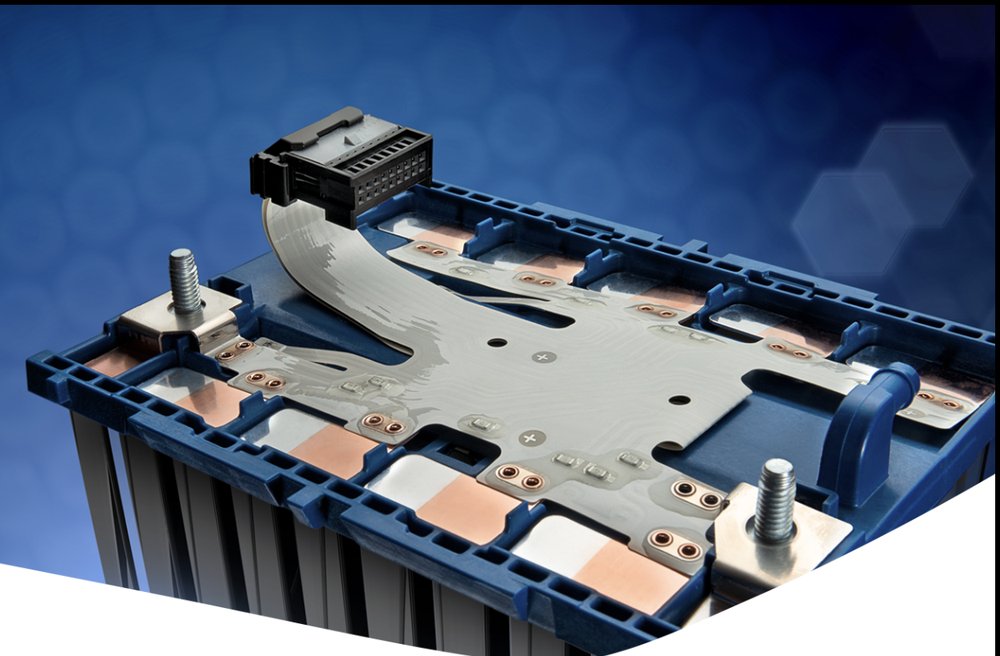
Battery-pack-level interconnects for cell-monitoring, temperature-sensing, and BMS electronics in electric drivetrains.
Camera, radar, and lidar module flex interconnects for driver-assistance systems.
Compact ECU interconnects and body-electronics flex cables for cabin systems.
Under-hood sensor tails for engine management, transmission, and aftertreatment systems.
TPMS sensor electronics and interconnects.
Display flex cables, head-unit interconnects, and in-vehicle infotainment assemblies.